

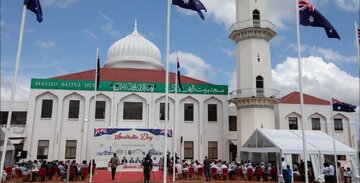
ABNA4 - The construction of the first mosque and Islamic center in Bendigo, southeast Australia, has been completed after 15 years.
In a move that marks a significant shift in the Muslim community in Australia, the city of Bendigo in the state of Victoria in southeastern Australia has witnessed the opening of its first official mosque and Islamic center after nearly 15 years, according to the Muslimsaroundtheworld website.
The opening ceremony was attended by the state’s premier and a number of dignitaries and religious leaders, an event that has symbolic value beyond mere construction and demonstrates coexistence and pluralism.
The event is seen as a remarkable social achievement that demonstrates the resilience of the Muslim community and its ability to achieve a long-term goal, in an environment that has previously seen debates and challenges surrounding the project. The opening of the Islamic center sends a positive message about the power of dialogue and cooperation.
The opening of the mosque represents the culmination of years of collective work and sustained support from the Muslim community, with the participation of individuals and institutions from diverse religious backgrounds, reflecting a living example of solidarity and collaboration.
The large attendance of dignitaries, including state and local leaders, along with representatives from interfaith dialogue networks, displayed clear support for the concept of religious pluralism and demonstrated that the official institutions see these projects as a positive element that strengthens social stability.
The minaret, built as part of the project, also symbolizes the official presence of Muslims in the city and their entry into a new phase of institutional stability.
The design of the mosque is inspired by the architecture of the city of Bendigo. Instead of the domes common in other mosques, the mosque has a “curved pyramid” roof, influenced by the traditional architecture of Bendigo’s courthouses.
The Victorian Government has provided $400,000 from the Multicultural Community Infrastructure Fund to implement the project. The plan for the center, designed by GKA Architects, was unveiled in 2016.
Asher Greenwood, one of the architects behind the center, said in 2016: “Since many of the clients are Syrian, we wanted the design to be consistent with traditional Syrian architecture.”
The event shows that the success of the project has been not only structural, but also social and cultural, and reflects the ability of communities to overcome challenges through dialogue and sending a clear message that the values of coexistence are stronger than hatred.
This experience confirms that the creation of religious institutions in Western societies is no longer just a religious need, but a social necessity that helps achieve balance and stability in diverse societies.
/129



Your Comment